
Maintaining Exercise Routines
The New year is now well under way! How are the New Year’s resolutions going? Alive and kicking or withering away in the corner? Was one of yours, “Maintaining exercise routines provided by my speech & language therapist”? If you’ve maintained or started practising regularly, well done you! 😊 And please do email us here at Speakmore to share your tips: hello@speakmore.co.uk
On the other hand, perhaps you’re struggling to stay motivated? Maintaining Exercise Routines can be especially hard to continue if you are no longer seeing your speech & language therapist for regular therapy. But if you’re struggling, help is at hand! Just read the tips below to re-motivate yourself and get back on track. You can do it!
1) Set yourself a goal. It’s always easier to set off knowing where you’re going rather than to blindly forge ahead. Without a goal, it’s easy to lose track, lose interest and become disillusioned. Start by identifying what it is you are aiming to achieve; is it a louder voice so you can order a pint in the pub? Feel more confident when ordering in a café? Being able to read stories to the children or grandchildren? Make a telephone call? Write a letter?
2) Now break your goal down into manageable chunks. For example, if your goal is to order a pint in the pub using your loud voice, start by practising single words such as, ‘Hello’, ‘Please’ or ‘Thank you’. Next try phrases such as, ‘I would like’, ‘A glass of wine’ or ‘A pint of bitter’. Build up to longer sentences so that eventually you can say, “I would like a pint of bitter and a glass of wine please.”
3) Keep practice sessions short and regular. Better to spend 5 – 10 minutes per day rather than aim for 30 minutes every day, or 45 minutes once a week.
4) Try to set a time to practise each day. Link doing your exercises with another activity such as meal times, or after you’ve brushed your teeth. Research shows that it is easier to link a new habit to an existing one. It can be helpful to book the time in your diary; even better – set an alarm on your phone or tablet to prompt you to practise.
5) Give yourself a little reward when you’ve finished, such as a nice cup of tea, doing something you really enjoy or just having a rest!
6) Change the exercises that you do each day. If you have a list of exercises, perhaps do a different task each day, or if you have several sheets, do one sheet one day and another the next. If you are still seeing your speech & language therapist, ask for plenty of exercises to keep the practice varied and interesting.
7) Find an ‘accountability’ partner. Who is this? An accountability partner is somebody who knows your goals and practice schedule and somebody to ‘report’ to saying how much you have practised. Your accountability partner can help you to identify how to practice, remind you of the benefits and encourage you to continue working towards your goal. They could be a friend, a partner, a child or grandchild or even a neighbour. Speakmore also offer an accountability partner service contacting you via telephone or FaceTime to have a chat, practise your exercises with you and provide constructive feedback to make sure you are doing them correctly.
Please contact Tracy at hello@speakmore.co.uk if you want to find out more about this service.
8) Don’t do it alone! It’s always easier if you have a regular session booked in and joining a group is always a fun option. Friends in the group can act as accountability partners too! Speakmore runs several groups for people with Parkinson’s in North Staffs, Stafford, Hednesford and soon one in Lichfield too. We also run a language based communication group in Stafford for people with communication difficulties following brain damage after a stroke, head injury or brain surgery. Our groups are always fun and new exercises are provided to help keep the practice interesting. Our groups are based on our unique ENGAGETM model – follow us on Facebook and the website to find out more about this model in the coming months.
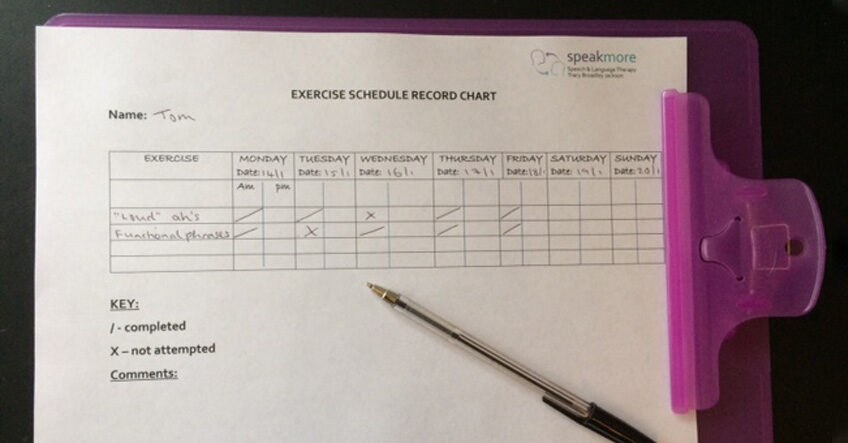
9) Use a daily tracker to keep a log of your practice – this can help you to see how much you have done and motivate you to keep the ticks going in the boxes. It might also help you to see if there are patterns, for example, you might realise that you practise more frequently if the you do it in the morning. For a free copy of our home-practice schedule email Tracy at hello@speakmore.co.uk
Don’t beat yourself up if you miss few practice sessions, just reward yourself for noticing and re-launch the practice with renewed determination!
And remember – exercise is medicine! (LSVT Global). We are often much better at taking our medication regularly, but overlook the benefits of doing the same with other habits. Don’t underestimate the benefits of daily practice.
“Motivation is what gets you started. Habit is what keeps you going” (John Rohn)
To learn more about developing good habits, check out people such as Hal Elrod. He argues that the key to success is getting started on the right track each day with a morning routine which includes exercise. If you follow his routine you could build your speech and language therapy excises into this routine! 👍 To find out more about this inspiring approach see: https://www.miraclemorning.com
Telling yourself you can do it is more than half the battle. So good luck and keep practising! Don’t forget to get in touch if you want a copy of our exercise checker, for support in doing your exercises or to join one of our groups via email: hello@speakmore.co.uk or telephone Tracy on 07798807811 😊
January 2019